China One-Stop Shoe Material Manufacturer
Looking for high-quality related shoe materials and industrial materials. We are a reliable Shoe Material supplier, offering personalized customization services, competitive prices and fast delivery services.
Introduce our products
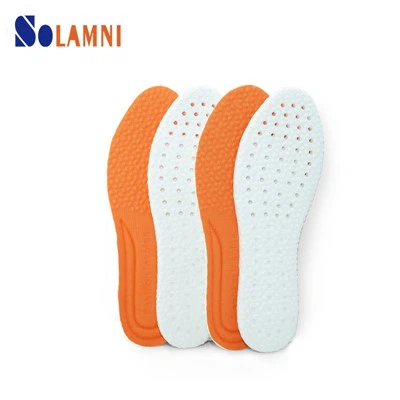
Running shoe insole: EVA/PU foam footbed, Asker C 35-55, arch support, moisture-wicking, anti-odor. MOQ 3,000 pairs, REACH/RoHS. Get free samples now!
A running shoe insole is a removable or cemented foam footbed inserted into running footwear, engineered to provide cushioning, arch support, moisture management, and pressure redistribution under repetitive heel-strike and toe-off loading. Solamni manufactures running shoe insoles from EVA, PU, memory foam, and TPE formulations in Asker C 35–55 hardness, with molded arch contours, heel cups, and breathable top fabric lamination. The facility supports OEM insole design, custom density zoning, and batch production from 3,000 pairs with REACH and RoHS compliance for global running footwear brands.

Technical Specifications Matrix
| Parameter | Specification |
|---|---|
| Base Material Formulation | EVA foam (injection / compression molded), PU foam, memory foam, TPE; optional PORON-equivalent heel pad |
| Hardness (Asker C) | Heel zone: 35 – 55; forefoot zone: 25 – 40; dual-density co-molding available |
| Density | EVA: 0.15 – 0.35 g/cm³; PU: 0.30 – 0.55 g/cm³; memory foam: 0.35 – 0.50 g/cm³ |
| Thickness Range | Heel: 4 – 10 mm; midfoot: 2 – 6 mm; forefoot: 1.5 – 4 mm (±0.5 mm) |
| Compression Set | ≤ 25% (EVA, 50% compression, 50°C, 6 h, ASTM D395); ≤ 15% (PU) |
| Energy Return | ≥ 55% (high-resilience EVA); ≥ 65% (PEBA-equivalent foam, optional) |
| Moisture Absorption & Desorption | Top fabric: ≥ 150% absorption; desorption to 80% RH equilibrium within 4 h |
| Flex Cycle Threshold | ≥ 200,000 cycles at 22.5° bend, no delamination or foam cracking |
| Arch Support Type | Neutral / medium / high arch; molded foam contour or rigid TPU arch insert (optional) |
| Top Fabric | Polyester mesh, nylon tricot, or bamboo-charcoal knit; anti-odor treatment optional |
| Weight per Pair (EU 42) | 40 g – 90 g |
| Size Range | EU 35 – 48 (US men's 4 – 14); trim-to-fit option available |
| Environmental Compliance | REACH SVHC, RoHS 2.0, OEKO-TEX Standard 100 (optional) |

Quality Control & Testing Standards
Asterism's running shoe insole QC protocol covers foam formulation verification, molded dimensional accuracy, bonded-fabric integrity, and performance durability under simulated running conditions.
Molding process control. EVA foam is compression-molded at 160–175°C with cure time locked per thickness (45–90 s per mm), and mold temperature is held within ±3°C by platen heaters. PU foam is poured into open molds with metered mix ratio (polyol : isocyanate) verified by gear-flow meters to ±1%. For dual-density insoles, two-shot molding or adhesive-bonded zone assembly is used, and the bond interface is peel-tested on every first-shot article. Top fabric is laminated using water-based adhesive at 3–4 g/m² with a heated roller press at 80°C.
Physical destructive testing (per batch, AQL 2.5).
- Hardness - Asker C durometer, 5 readings per zone (heel / midfoot / forefoot), ASTM D2240.
- Density - water displacement method, ASTM D792, 3 specimens per batch.
- Compression set - 50% compression, 50°C, 6 h, ASTM D395.
- Energy return - mechanical drop-test rig, 8.5 kg mass from 50 mm, rebound height measured.
- Flex resistance - Ross flex tester, 200,000 cycles at 22.5°, inspection for foam cracking and fabric delamination.
- Moisture management - AATCC TM195 absorption and desorption rate test on top fabric.
- Bond peel strength - top fabric to foam, 15 mm strip, 300 mm/min, ≥ 3 N/15 mm.
- Dimensional accuracy - CMM or 2D projector, arch height ±0.5 mm, heel cup depth ±0.5 mm vs. CAD.
- Color and print - spectrophotometer ΔE ≤ 1.5; logo print adhesion verified by tape test (ASTM D3359).
Chemical and regulatory testing. Each foam raw material lot is verified by melt flow index (EVA) or isocyanate index (PU). Finished insoles are screened by GC-MS for REACH SVHC and ICP-OES for RoHS restricted elements. Anti-odor treated insoles are tested by ISO 20743 (antibacterial activity) against Staphylococcus aureus, with reduction rate ≥ 99% required. Third-party SGS or Intertek reports are available on request.
Equipment backing production stability. The plant operates 6 compression molding presses (200T–400T), 4 PU pouring lines with automated mix heads, 2 EVA injection molding machines, 3 fabric laminating lines, a CNC contour cutting station, and an automated insole-weight sorter. This setup supports density variation below 5% across cavities and consistent arch contour across high-volume runs.
Industrial Application Scenarios
Road running shoes (neutral cushion). Medium-density EVA insoles (Asker C 40–45) with molded neutral arch contour and breathable polyester mesh top fabric are standard for daily training road running shoes. Heel thickness of 6–8 mm provides impact attenuation, while forefoot thickness of 2–3 mm preserves ground feel during toe-off.
Trail running shoes. Higher-density EVA or PU insoles (Asker C 45–55) with moisture-wicking nylon tricot and anti-odor treatment are specified for trail running, where foot moisture and bacterial buildup are elevated. A deeper heel cup (8–10 mm) improves rearfoot stability on uneven terrain.
Racing flats and carbon-plate shoes. Thin, high-resilience EVA or PEBA-equivalent foam insoles (Asker C 35–40, forefoot thickness 1.5–2 mm) minimize stack height and maximize energy return (≥ 60%) for race-day footwear. Lightweight construction targets below 50 g per pair.
Stability and motion-control running shoes. Insoles with a denser medial post (Asker C 50–55) or an embedded TPU arch insert provide overpronation control. Dual-density co-molding allows the lateral forefoot to remain flexible while the medial side resists excessive inward roll.
Aftermarket and replacement insoles. Solamni supplies trim-to-fit replacement insoles to running specialty retailers, online marketplaces, and podiatry clinics. Standard sizes cover EU 35–48, and the top fabric is printed with size-gradation cut lines for consumer trimming.
Adjacent footwear. The same foam formulations and molding lines extend to walking shoes, casual sneakers, work boots, and tactical footwear where all-day cushioning and moisture management are required.
FAQ

Q: How does dual-density zoning in a running shoe insole balance heel impact cushioning and forefoot propulsion?
Q: How durable is the anti-odor and moisture-wicking treatment through washing cycles?
Q: What is the tooling cost and minimum order for a custom-contoured running shoe insole?
Products shows


Hot Tags: running shoe insole, China running shoe insole manufacturers, factory, inner soles for shoes, insole price, shoe insoles size 6, shoes with high insoles, shoes without insoles, size 6 shoe insoles
why choose us

why choose our products
We specialize in providing premium-grade materials for industrial applications. Our focus on wholesale sourcing ensures you receive competitive pricing on large orders, alongside flexible fabric customization to meet your exact specifications. Whether you need high-volume production runs or specialized orders, we ensure your success with fast delivery and exceptional support.
- Bulk Sourcing: Competitive pricing for large-scale orders.
- Customization: Flexible solutions tailored to your industry needs.
- Global Shipping: Fast, reliable delivery to international markets.
- High-Quality Standards: Rigorous testing and quality assurance to ensure performance and durability.

Elite Partners
Direct collaboration with DHL, FedEx, UPS, TNT, and EMS to ensure maximum shipping efficiency.
Custom Logistics
Flexible options covering air freight, sea cargo, and express door-to-door delivery.
Secure Transit
Professional packaging and full-course tracking for peace of mind.

Our Advantage
Sourced for Excellence: We meticulously select only premium-grade raw materials.
Expert Craftsmanship: Our team comprises experienced technicians operating advanced machinery.
Proactive QC: We implement rigorous in-line inspections throughout every stage of production.
Zero-Risk Standards: A dedicated QC team performs final double-inspections, fully compliant with your chosen AQL standards before packaging.
Unwavering Consistency: We maintain a strict, non-negotiable commitment to top-tier quality.
fAQ
A1: Approximately 25-35 days after all specifications and order details are confirmed.
A2: We typically require a 30% deposit in advance with the remaining 70% balance due before shipment. Alternatively, we accept a 50/50 split depending on the final order quantity.
A3: We accept T/T (Telegraphic Transfer), PayPal, and Western Union.
A4: Free samples are available! Custom sample preparation takes about 3-5 days once all details are confirmed
ASTERISM Import And Export Co., Ltd.
Let's build a profitable future together. We sincerely welcome global clients for long-term strategic cooperation. Contact us today-our team is ready to respond to your inquiries swiftly.
ace01@eurus-cn.com +8613459576329
Whatsapp+8613459576329